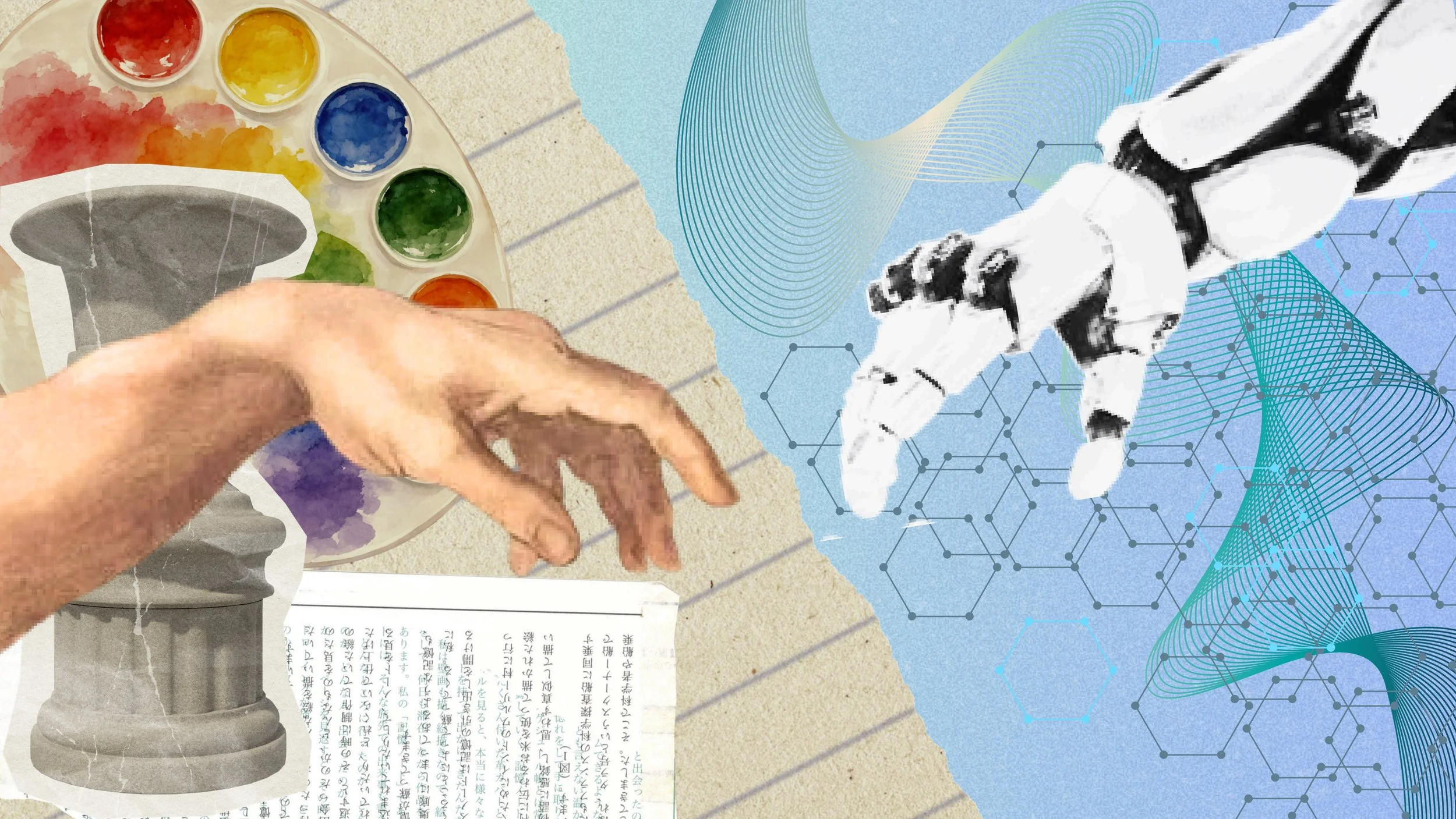
On October 7, students participated in the Student-Led Discussion on AI & Art, an open forum co-led by Courtmae Dimabuyu ‘29 and Olive Trias ‘29. Here, participants used prepared guiding questions to discuss their opinions on AI’s use in art in Julie Billiart Hall during lunch.
Artificial intelligence (AI) has been a growing concern among artists who fear that their passion is being replaced by computer-generated, stolen work, and there’s been much discourse on the ethics of using AI in art. Dimabuyu and Trias reached out to administration with their concerns, and they collaborated with Arts Integration Specialist Alexandra Cunningham to come up with a solution to highlight student voices.
Dimabuyu and Trias said they felt compelled to take a stance on AI following Notre Dame High School’s Instagram account posting an AI-generated picture of what The Center of Women’s Leadership would have looked like in 1851, trying to celebrate its 175th anniversary.
This post created significant controversy among students. Many agreed that it is hypocritical for the school to use generative AI when students have strict policies regarding AI usage for their work, and argued that a school focused on women’s leadership should have taken the opportunity to showcase students’ artwork in its thriving visual arts program.
The Student-Led Discussion allowed students to examine the role of AI in art, and the overwhelming opinion was that AI should have no room at all. The main concern was that images created by AI are not actually original pieces of art, but rather a combination of patterns and code from visual media across the internet that are trained to mimic often unconsenting artists.
According to The New York Times, large companies like OpenAI, Google and Meta have scraped large quantities of digital media to use to build and train their AI models, much of it including the intellectual property of artists and authors. Though some have filed lawsuits over copyrighted material caught in data collection, companies are legally allowed to use artists' work without their permission under fair use in copyright law by configuring the original material into a different image.
Legality doesn’t automatically equate with ethicality, however. Students voiced that artists recognize their artwork as an inherently human endeavour, where each piece of art is a reflection of their creativity, emotion and labor that went into its creation. For a machine to translate their work into code and numbers to output an emotionless, often low-quality result makes artists concerned about their hard work being stolen. Especially considering that art used for image generation is applied without crediting or gaining consent from the artist, creatives feel that the originality and talent they put into their passions are being taken advantage of to create a cheaper copy.
There are other concerns surrounding AI use that students brought up, like the environmental impact of data centers that are disproportionately impacting people of color and low-income communities. Students spoke of concerns about how AI usage limits the users’ critical thinking and creativity, and that individual use encourages companies to continue investing in AI regardless of the ethical implications. With continued usage, this sends a message that these ethical concerns do not need to be addressed to make a profit, and that companies can continue with the same business model regardless of negative impacts.
Still, generative AI continues to be a nuanced conversation in the community. Students, even if they agree that AI use is wrong, can feel pressured to use it to assist them in their work and classes. With this technology so readily available in education, it’s tempting to take the easy way out. This applies to faculty as well; while some teachers strictly prohibit AI, others use it for classroom decor, assignments, activities, presentations, study tools, and even emails to students. There’s not a clear line enforced at ND where AI should be prohibited and where it should be allowed.
With AI and art, the community is still determining its path forward. Cunningham said, “AI can be such a beneficial, powerful tool, but it can also limit our creative thinking and take credit and income away from artists and creators. I have seen really cool impacts around efficiency, resources, and practice, but I have also seen some concerning effects around authorship, individuality, and lack of independent thinking.” With the conclusion of the Student-Led Discussion on AI & Art, students were able to fill out a form that would let them suggest more topics for AI-focused discussion in the future.
There’s no denying that AI is an innovative technology that is constantly evolving in today’s day and age, and the difference between art and automation has been getting blurred as a result. Despite the uncertainty, ND is proud to have a community of committed artists and social justice advocates who are open to collaborating on better solutions to navigate our ever-changing technological landscape.